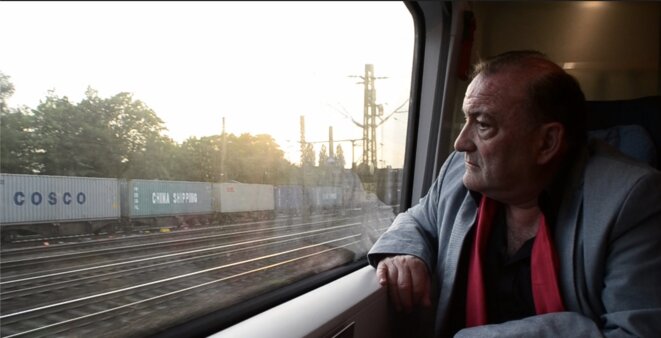
La thématique principale de l’exposition porte sur le mensonge et la contrefaçon dans notre monde globalisé dont la Chine contemporaine ne constitue certes qu’une partie, pour autant essentielle. C’est cette mondialisation que Guy Debord a théorisée à la fin du siècle dernier dans ses Commentaires sur la Société du Spectacle (1988) où il revisite son ouvrage de 1967 La Société du Spectacle.
The overarching theme of the exhibition relates to the falseness and the fake of our globalized world, of which contemporary China is only, but nevertheless an essential, part. This was a globalization that Guy Debord theorized towards the end of the last century in his revisiting of the Society of the Spectacle (1967) entitled Comments on the Society of the Spectacle (1988).
Presentamos un notable hallazgo del poeta chino Ai Qing: “Sobre un promontorio de Chile”, dedicado a Pablo Neruda. "Ai Qing: Un poema para Neruda". Traducción y nota de Gregory Lee.
The recent and intense attacks on what has been labelled Islamo-leftism, Islamo-gauchisme in the original, is the French iteration of a more global attack on “woke leftism”, or specifically critical race theory, gender studies and postcolonialism, summarized by France’s President Macron as the threat of “certain social science theories from the United States”.
Trump’s #chinesevirus tweet ethnicized and weaponized, COVID-19 as the “Chinese virus”. This link has lodged in the dominant white collective imagining of “the Chinese”, and now must be counted with the handful of other myths and scraps of “common sense”that go to make up that imaginary.
How can Ellul, Castoriadis and Rensi, together with Zhuangzi, whose philosophies proceed unwittingly in parallel like four ships in the night, help us to understand and imagine how we might retreat from, or even transcend, the cataclysmic moment that humanity is currently experiencing, a moment of which the coronavirus may be seen as a tragic epiphenomenon.
Castoriadis, wrote very little that directly dealt with Chinese politics. What is striking, however, is how with a time-lag of between ten and twenty years, Castoriadis's analysis of the Soviet Union may be mapped onto Mao's China. Even today looking at Xi Jinping's China the insights of Castoriadis ring true.
There is no way I could not like Jennifer Lee Tsai’s poetry, a poetry that rises like mist off the mingling tides of the rivers Mersey and Pearl. Her poetry is written out of lived experience, and so rings true. Its “Chineseness” seems natural, woven-in, not forced, not precious or ostentatious. But Tsai’s is above all a personal and ‘local’ poetry —in the best senses of both terms.